Introduction
What is AOP?
The Advancis Open Platform (AOP) is first of all a component model for service-oriented software design.
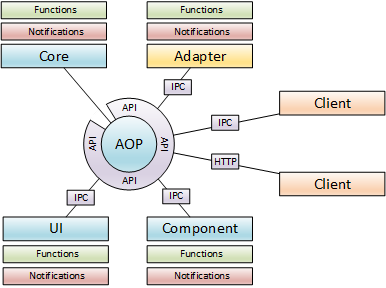
The AOP Core provides the API via IPC on the AOP Node and allows components to connect. These can include UI components, device adapters and other extensions.
Each component can register its own services with functions and notifications and thereby extend the API. In other words, the components simultaneously use and form the API.
Since IPC uses only standard technologies (HTTP, WebSockets, JSON), basically any programming language can be used to create components.
Components that do not provide their own services are referred to as clients. The scope of API usage for the various components can be defined through configuration and licensing.
What makes the API special is that it is designed for both simultaneously - that is, to create a component-based application (the App) as well as to provide external access to that application.
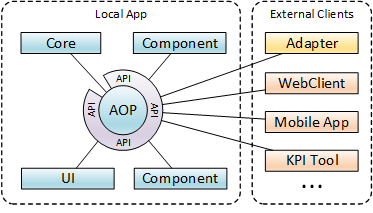
In addition to this component model, the Advancis Open Platform also offers a collection of existing services and ready-to-use features, including Rights, Settings, Data Objects, Device Adapters, and more.
AOP has evolved from WinGuard and now forms its foundation. The services and concepts are inspired from there and the transition is fluid. So far, the API does not clearly separate the two.
In a WinGuard network, each station forms its own AOP Node:
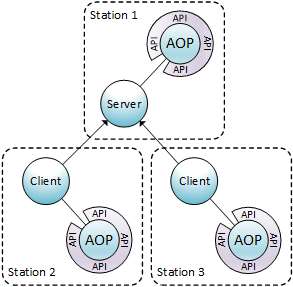
Access to the WinGuard system is possible at each of the Nodes, with the restriction that only data available at that respective station can be accessed.
The Nodes are not connected directly, but via the WinGuard network. In this way, services can also be routed between Nodes. The creation of networked components is thus possible.
The services of the API are defined independently of concrete programming languages or transfer protocols. AOP uses its own data model and logical value types.
However, it is usually not necessary to deal with these details. The available SDKs encapsulate most of the details of component implementation and usually map the API completely into the respective programming language.
The scripting feature within the app is also based on the API and is the easiest way to explore and use it for your own purposes.
About this document
This document is primarily intended for AOP developers, but it is also designed to provide the general reader with insights into AOP and its capabilities.
The sections are structured so that general information is provided at the beginning, followed by more technical details.
Basics - describes the fundamental concepts relevant to every AOP component, some of which are quite technical, including network protocols and file formats.
Features - describes the ready-to-use features and conceptual approaches offered by AOP. Their use is optional for components; none of them is required.
Extensions - describes the general concept of extension development and provides details on the different types of extensions.
Quick Start - provides step-by-step guides and tips designed to help you get started with AOP.
API - contains a comprehensive description of all available services, organized by skills. It is intended as a reference guide for both extension development and scripting.
FAQ - provides answers to questions that frequently arise when working with AOP.
Links - take you to additional information and documents.